

Use Cases
Discover real-world examples of digital wallets and verifiable credentials in action — passwordless login, age verification, digital travel, cross-border and public services, and more. Learn from proven patterns, compare approaches, and reuse what works instead of starting from scratch.

Cryptographically Verifiable Digital Product Passports for EU Battery Regulation Compliance
by AAS-Studio
European manufacturers must issue Digital Product Passports (EU Battery Regulation 2023/1542, from 18 February 2027, with the ESPR extending this to further categories). Today the data those passports need lives in unstructured PDF datasheets, and manufacturers have no way to prove a downstream party has not altered the file after publication. AAS Studio turns a datasheet into a conformant Asset Administration Shell (IDTA, IEC 63278-1:2023), then issues a W3C Verifiable Credential (VCDM 2.0, JWT-VC, and an SD-JWT-VC variant with selective disclosure) committing to a canonical hash of the passport content. The manufacturer is the issuer, signing with a tenant-scoped ES256 key. Any verifier — regulator, recycler, supply-chain partner — checks the credential against a public JWKS with no account and no call back to AAS Studio: verification is fully offline. Revocation is enforced via a Bitstring/Token Status List.
- Sector
- Manufacturing
- Country
- Portugal
- Production deployment
- No
- More information
- https://aas-studio.eu/verify
- Last updated
How it works
1. Manufacturer uploads a PDF datasheet; AAS Studio extracts the regulatory fields
with an LLM ensemble and maps them onto a conformant Asset Administration Shell,
validated against the official IDTA test engine.
2. AAS Studio computes a canonical hash of the passport content and issues a W3C
Verifiable Credential signed with the manufacturer's own ES256 key, optionally
as an SD-JWT-VC for selective disclosure.
3. If issued as revocable, a Bitstring/Token Status List slot is allocated; the
manufacturer can revoke it later, effective immediately for any verifier.
4. The holder presents the credential's JWT to a relying party by any channel.
5. The relying party verifies it fully offline: it fetches the public JWKS and
re-derives the proof itself, including the status-list check, so the verdict
never depends on trusting AAS Studio's server.
Tags
- digital-product-passport
- verifiable-credentials
- battery-regulation
- manufacturing
- supply-chain
- sustainability
Interaction modes
- Remote flow
VC formats
- JWT VC
- SD-JWT VC
- VCDM2.0
Issuance protocols
- Other
Issuers involved
- AAS-Studio
Credential types used
- DigitalProductPassportCredential
Showing 24 of 101 items
-
Cryptographically Verifiable Digital Product Passports for EU Battery Regulation Compliance
European manufacturers must issue Digital Product Passports (EU Battery Regulation 2023/1542, from 18 February 2027, with the ESPR extend…
-

Verifiable AI fairness: a seal for the system, a receipt for the person
When an AI screens a job application, scores a loan or decides a benefit, the person affected gets a decision but often no way to verify…
-
Faster onboarding, a complete employee record from day one!
From intake, skills passport and skills assessment to vocational education certificates in her own wallet. When she applies for a job, th…
-
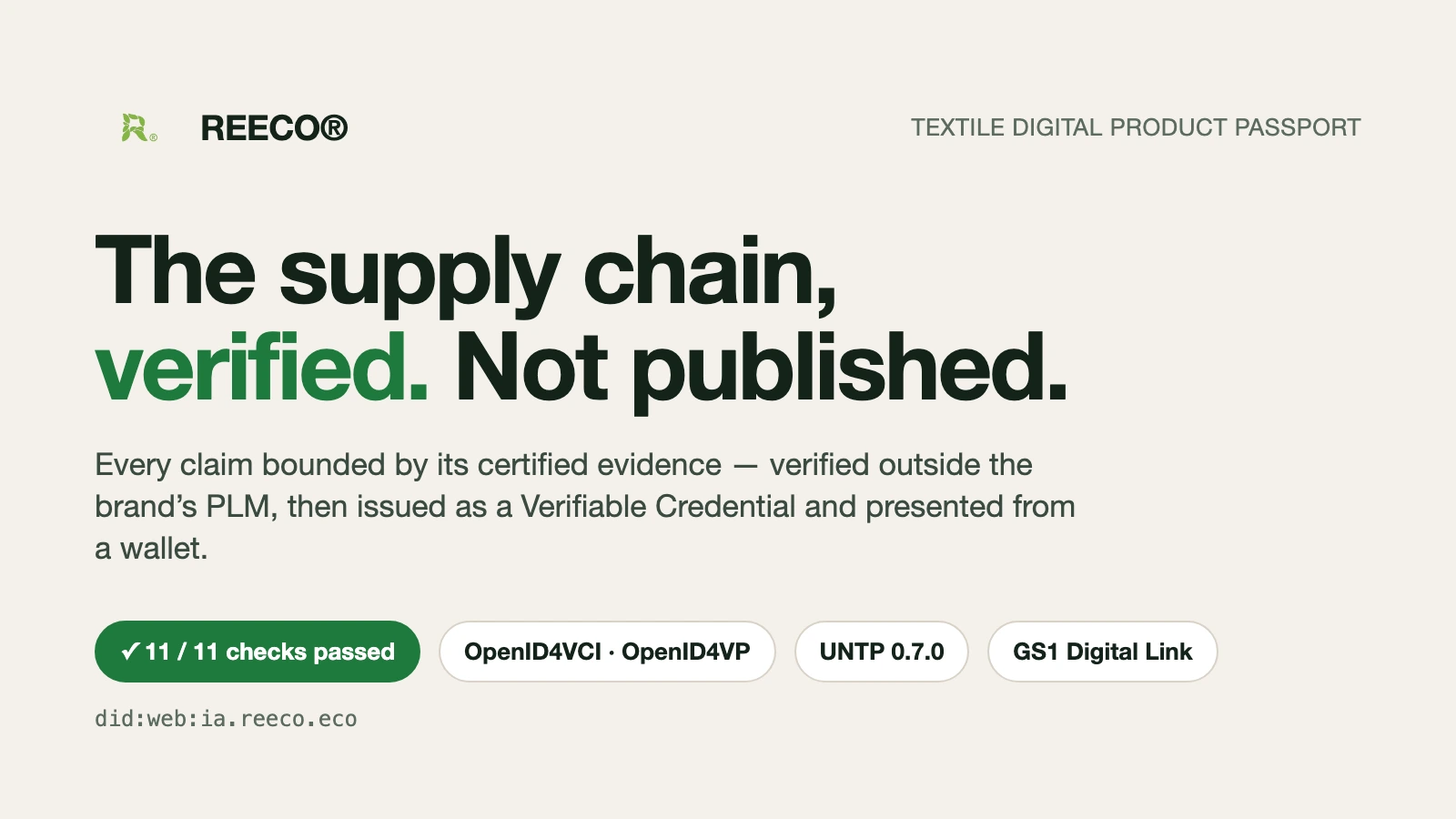
Reeco Textile DPP : the supply chain verified independently of the brand's systems
Textile passports today publish what a brand exports from its PLM. A signature makes that tamper-evident, not true. Reeco verifies the ch…
-
Portable pentest, compliance and privacy credentials for supply-chain trust
Problem Every business now has to prove its security and privacy posture to customers, regulators and partners. That proof travels as PDF…
-

From Mine Permit to Digital Product Passport: Building an Open Digital Trust Ecosystem for Responsible Critical Minerals
Energy & Mines Digital Trust began with a use case, as shown in the video, in which production-issued digital credentials are held in a m…
-

End-to-End Digital Business Workflows: Transforming KYB-KYC-KYS via EU Business Wallet
Use Case: This end-to-end digital business workflow automates and secures high-assurance onboarding across the business lifecycle - Know…
-

Trusted eReceipts for B2B Payments: Issuing verifiable receipts to a European Business Wallet after EUDI-based SCA
Verifiable eReceipts for SME business purchases: An SME buys online. An authorised employee approves the payment with Strong Customer Aut…
-

Digital Certificate of Good Conduct (VOG) as a Verifiable Credential
Every year, 1.8 million Certificates of Good Conduct (VOGs) are issued in the Netherlands. Over 350 large organizations and 26,000 sports…
-

DIFO - Digital Invoice Financing Origination for SMEs (Serbia & Romania pilot)
DIFO is an open-source protocol, developed in partnership with Finspot, IFC, World Bank, GLEIF and Global vLEI AB. It uses zero-knowledge…
-

CredIssuer by Ooru - Verifiable Work-Completion Credentials for Migrant Construction Workers
India's Building and Other Construction Workers (BOCW) scheme entitles a migrant construction worker to welfare benefits once they comple…
-

Cross-Border Micro-Credentials: The EU.ACE Chain (EU - CH)
A student completes a university programme and receives a digital credential in their wallet. Instead of a PDF that another institution o…
-
Autofill Customer ID on Trip.com with Google Wallet
Travellers can securely share authorised identity information from an ID Pass in Google Wallet to automatically populate the passenger de…
-
Digital Twin based Verifiable Credentials for local impact, proven on the Open Interop Testbed
itb.ilabs.ai is in production: a GITB test bed operated by iLabs, with external accounts, listed on fides.community as the Open Interop T…
-

Credenid - Fast KYB and corporate onboarding with a business wallet
This use case demonstrates reusable, wallet-based KYB for corporate account opening. Companies and their representatives currently submit…
-

HIMS eSPA - Electronic Sale and Purchase Agreement using Digital Signature
Business challenge: Malaysia’s property Sale and Purchase Agreement process traditionally requires physical identity checks, appointments…
-

Instant, Paperless Rural Credit Using Verifiable Credentials
Rural credit in Brazil traditionally requires farmers to gather paper land and environmental documents for manual bank review, causing de…
-

Instant Digital Verification of Education Credentials using VerifyTT
VerifyTT is Trinidad and Tobago's national platform for issuing, holding, and verifying digital credentials, starting with academic certi…
-
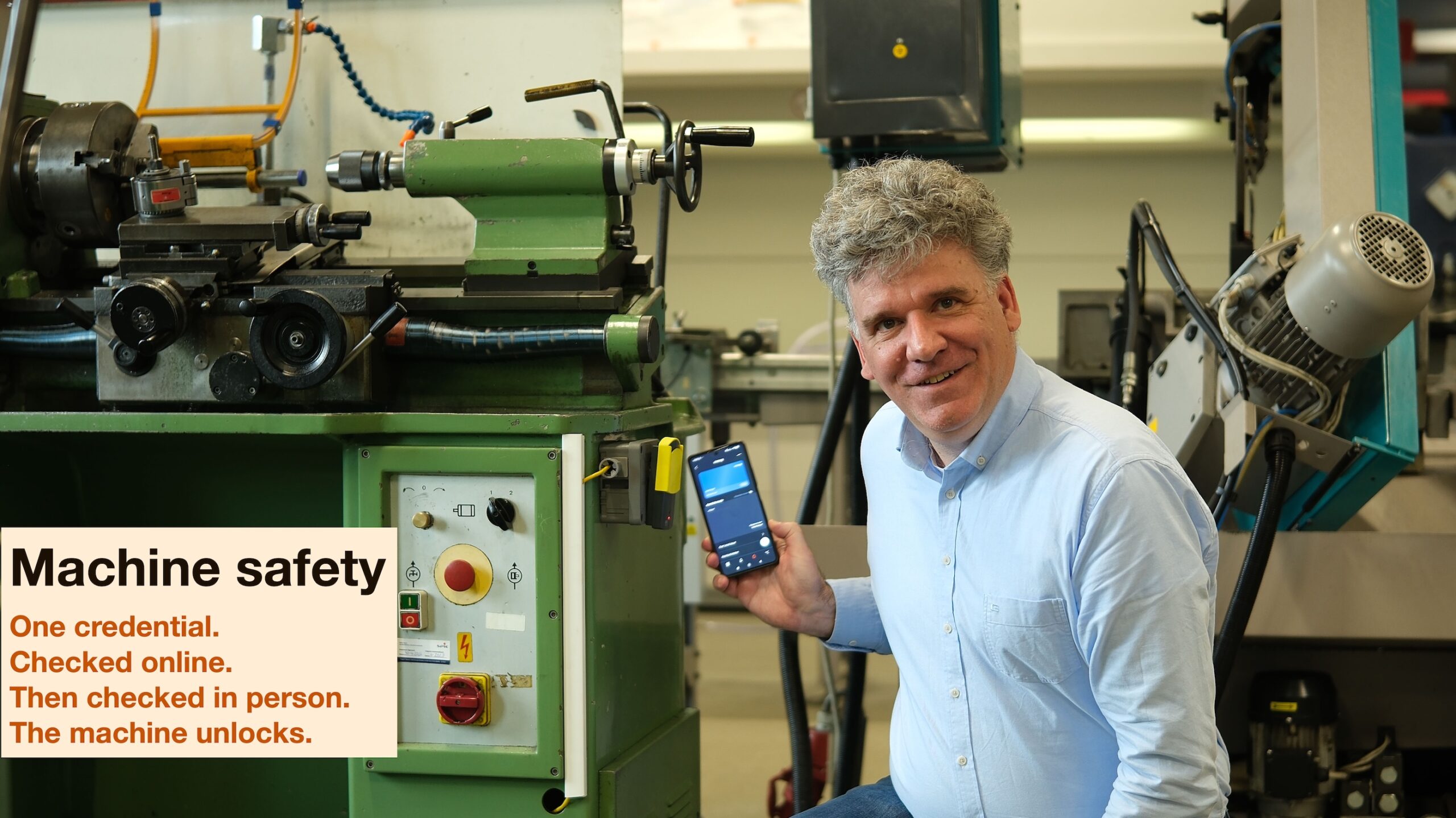
Verified machine safety access at Koning Willem I College (KW1C)
A student is trained on a high-risk workshop machine and receives a digital machine safety certificate. That same digital certificate let…
-

Arattai: Verified Social Media Profiles
Arattai is an Indian instant messaging and social networking platform (Like WhatsApp and Signal) with 8 million users that enables users…
-

Urban Company: Service Professional and Customer Identity Verification
Urban Company (Think Helpling, Taskrabbit, Bark etc) is one of Asia's leading technology platforms for 8.4 million users delivering home…
-

Hala Mobility: Verified Rider Onboarding
Hala Mobility is an electric mobility platform that manufactures and rents electric scooters to delivery partners, enabling last-mile log…
-

Neoflow Digital Energy Passport for Cross-Border Crude Oil Clearance
Neoflow operates a digital rail for energy traceability across the Canada-U.S. border. Every batch of crude oil crossing by pipeline now…
-

Vesta Appliances: from impostors to Proof-of-Trust
Vesta Appliances is a fictional Swiss manufacturer with a very real problem: forty years of brand trust and no way to prove it online. Cu…
Loading use case catalog…
Use desktop to add or update
Add or update a listing
The FIDES Use Case Catalog aims to provide a clear and up-to-date overview of how verifiable credentials and digital wallets are used in the real world. While FIDES Labs BV does not assume responsibility or liability for the completeness, accuracy, or timeliness of the information presented, we have made a best effort to compile a representative overview. The data is aggregated from publicly available sources and from information published by the organisations themselves.
Add or update a use case:
- List your organization first (if it is not in the Organizations catalog).
- Then submit a use case or suggest an update to an existing use case.
Both flows require a FIDES Community account. Submissions are reviewed before publication.
- Add use case
- Update use case — find your use case and submit changes
- Logged-in users can also use Suggest an update (pencil icon) in a detail view of a use case.